SERIES 1: Don’t Just Spin It! Understanding the Difference Between Agitating-Mixing and Dispersion
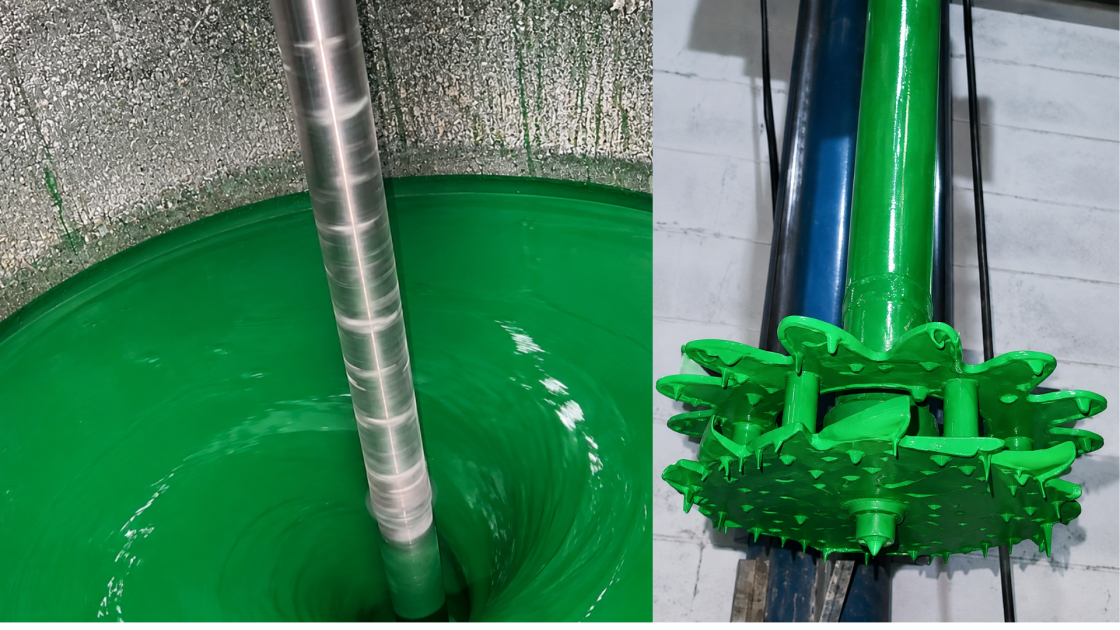
1. Fundamentals of Hydrodynamics
Many operators across local manufacturing industries assume that as long as a mixer blade is rotating and the liquid is moving, the mixing process must be working properly. This is a major misconception.
In industrial liquid processing, it is essential to distinguish between two fundamentally different processes: Agitating-Mixing (Blending) and Dispersion.
Agitating-Mixing (Blending) is primarily intended to combine liquid components into a homogeneous mixture, dissolve soluble materials, or keep solid particles suspended to prevent sedimentation. This process generally requires low shear and high pumping capacity. Typical applications include final shampoo blending, liquid fertilizer dilution, and resin dilution.
Dispersion, on the other hand, is the process of breaking down and deagglomerating solid particles or pigment agglomerates into smaller, more uniformly distributed particles within a liquid medium. Effective dispersion requires high shear forces to break down these agglomerates and achieve a stable dispersion.
The primary equipment used for this process is the High Speed Disperser (HSD), typically equipped with a Cowles-type toothed blade. The effectiveness of dispersion should not be judged simply by motor power or drive RPM. One of the key parameters is Tip Speed, which represents the linear velocity at the outer edge of the disperser blade.
2. Standard Tip Speed Calculation
For many paint and pigment dispersion applications, an effective target tip speed is commonly established within the range of approximately 22–25 m/s, depending on the formulation and process requirements.
The RPM required to achieve a specific tip speed can be calculated using:
RPM = (Tip Speed × 60) / (π × Blade Diameter)
Where:
- Tip Speed = blade tip velocity (m/s)
- Blade Diameter = disperser blade diameter (m)
Operating below the required tip speed may result in insufficient shear and incomplete pigment deagglomeration, potentially affecting dispersion quality and properties such as hiding power.
On the other hand, excessively high tip speeds can generate unnecessary heat, increase air entrainment and foaming, and potentially affect the stability and quality of the formulation.
Therefore, the appropriate tip speed should always be determined based on the formulation, viscosity, pigment characteristics, blade geometry, tank configuration, and process requirements.
3. Field Experience & HSD Optimization
Although both HSDs and agitators are commonly referred to as "mixers" in the field, their operating principles and applications can be significantly different.
Many manufacturers operate High Speed Dispersers based primarily on field experience and conventional practices without fully considering the fundamental differences between blending and dispersion.
In pigment dispersion, the key parameter is not simply the motor RPM, but the tip speed and the interaction between blade geometry, tank geometry, material properties, and operating conditions.
If the appropriate operating parameters are not achieved, production efficiency and dispersion quality can be significantly affected.
Blade-to-Tank Ratio
The blade-to-tank diameter ratio is an important design consideration. A tank that is too wide relative to the blade may create insufficient circulation near the tank wall and lead to dead zones.
Conversely, an excessively large blade relative to the tank can create excessive turbulence, splashing, and air entrainment, which may negatively affect the process.
Blade Position
The blade position is another critical factor.
For conventional centered HSD configurations, the shaft is typically positioned at or near the center of the tank to establish the desired circulation pattern and doughnut effect.
Incorrect positioning can reduce the effectiveness of powder incorporation and circulation, causing dry pigment or powder to remain on the surface instead of being efficiently drawn into the high-shear zone around the disperser blade.
Blade-to-Bottom Clearance
The clearance between the disperser blade and the tank bottom must also be properly selected.
If the blade is positioned too close to the bottom, circulation can become restricted and the mixer may experience increased load or torque.
If the blade is positioned too high, heavier pigments or solids may accumulate at the bottom and remain outside the effective circulation zone.
The appropriate clearance should therefore be determined based on the blade diameter, tank geometry, formulation properties, viscosity, solids loading, and required circulation pattern.
Impact of Improper Design and Operation
Ignoring these fundamental parameters can lead to:
- Significantly longer processing times
- Incomplete pigment dispersion
- Increased energy consumption
- Excessive heat generation
- Excessive foaming or air entrainment
- Poor product consistency
- Increased mechanical loads
- Premature wear of shafts, bearings, and other mixer components
Proper HSD optimization is therefore not simply about selecting a larger motor or increasing RPM. It requires an understanding of the relationship between tip speed, blade geometry, tank geometry, material properties, and process conditions.
Technical Discussion & Consultation
Need assistance with a mixing or dispersion process audit, HSD tip speed calculation, or disperser blade design optimization?
Our Application Engineering team can help evaluate your existing equipment and recommend suitable improvements based on your process requirements.
Contact PT Rho Sigma Trijaya (RST) for technical consultation and industrial mixing solutions.
Technical References
- Patton, T. C., Paint Flow and Pigment Dispersion, 2nd Ed., Wiley-Interscience.
- Morehouse Cowles Engineering Manual, Operation & Dispersion Technology Guide.
- Paul, E. L. et al., Handbook of Industrial Mixing: Science and Practice, John Wiley & Sons.